
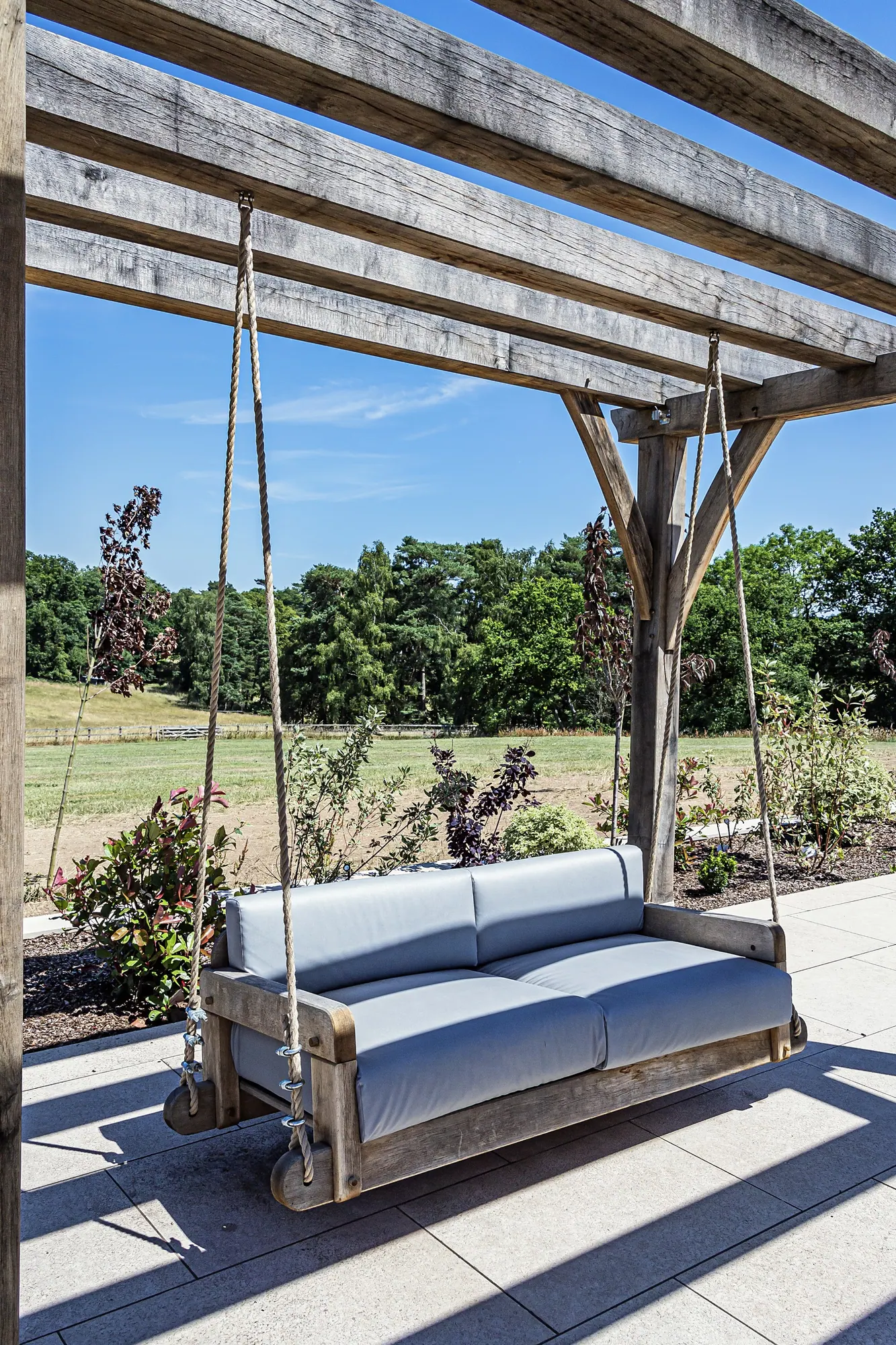
Drive through Monmouthshire, Herefordshire or the Welsh Marches and you pass oak frames constantly — in barns, in church roofs, in the bones of half the older houses in every village. It is easy to assume the craft that built them has simply carried on.
It very nearly did not. For most of the twentieth century, almost nobody in Britain was cutting new oak frames. The trade survived in a handful of repair workshops and in the heads of a small number of people who had learned it from someone older. That it exists as a working industry today is a recent and slightly improbable thing.
What ended it
Oak framing did not die because it stopped working. It died because it stopped being competitive.
Brick became cheap in the eighteenth and nineteenth centuries, and cheap brick with a softwood roof was faster to build and needed less skill. By the Victorian period, timber framing already read as old-fashioned. Then the mature oak stock went — first into shipbuilding, then into two world wars — and by the middle of the twentieth century Britain had neither the trees nor the demand.
What finished it was the post-war building programme. Speed and volume were the entire brief. A structural system that required a skilled carpenter to cut every joint by hand was the opposite of what the country wanted. Framing survived as conservation work — patching medieval buildings — rather than as a way of making new ones.
What brought it back
Three things, roughly in this order.
The conservation sector kept the knowledge alive. People repairing listed buildings had to understand how the originals were cut, and that understanding is the same understanding you need to cut a new one. The craft persisted as a repair discipline for decades before it became a building discipline again.
The self-build movement created demand. From the 1980s onwards, more people were commissioning individual houses rather than buying from a developer, and some of them wanted something with more character than a timber-kit box. An oak frame was a way of getting a building that felt made rather than assembled.
And glass got better. This one matters more than it sounds. A traditional frame was infilled with wattle and daub or brick. Modern sealed units, and the detailing that lets glass meet a moving timber frame without failing, made it possible to glaze the bays instead — and that is the look most people now picture when they think of an oak frame. The renaissance is as much a glazing story as a timber one.
What has genuinely changed in the workshop
The joints have not. A mortice and tenon pegged with a riven oak peg is the same joint a fourteenth-century carpenter would recognise, and for the same reasons: it is strong in the directions timber is strong, it tolerates movement, and it does not rely on a fastener that will rust.
What has changed is everything around them.
Design. Frames are drawn in three dimensions now, and modelled before anything is cut. A carpenter in 1450 laid the frame out full size on a framing floor and scribed each joint to its neighbour. We can resolve the geometry before the timber arrives, which means less waste and fewer surprises at raising.
Engineering. Spans that would once have been settled by judgement and precedent are now calculated. That is not a loss. It means we can be more confident about larger openings, and it means a building control officer has something to read.
Machines for the rough work. Nobody misses converting a green oak beam to size with an axe. Machines take the timber to dimension, and the CNC at our sawmill now cuts the simple mortices and square tenons from our own files; the complex joints are still cut, pared and fitted by hand, because that is still the part where the quality lives.
Cranes. Frames used to go up with block and tackle and a great many people. A telehandler does in a morning what took a village a day.
What has not changed
The material still moves. Green oak shrinks and shakes as it dries, and no amount of modelling stops it. Frames are designed around that movement in exactly the way they always were — joints that can tighten, tolerances that allow the timber to work.
The judgement has not changed either. Knowing which face of a beam to put outward, where a shake is cosmetic and where it matters, how much to leave for movement at a particular junction — none of that is in the model. It comes from having cut a lot of oak.
And the sequence has not changed. Cut, dry-fit, take down, transport, raise. The frame is assembled at the workshop before it ever reaches your site, because finding a problem at the workshop costs a morning and finding it on site costs a week.
Where it goes next
The interesting pressure now is environmental. Timber is the only mainstream structural material that stores carbon rather than emitting it, and that argument is getting stronger rather than weaker. Oak framing is a small corner of a much larger move back toward building in wood.
The risk is the same one that killed it the first time — that it becomes a decorative option rather than a structural one. Fake frames exist: softwood or steel with oak-look cladding stuck on. They are cheaper and they are not the same thing, and part of the job now is being clear about the difference.
Come and see it
The most direct way to understand any of this is to watch a joint being cut. Visits to the workshop near Abergavenny take an hour or two — whatever frame is on the floor that week, the team, and a cup of tea. No obligation and no sales pitch.
Related reading

