
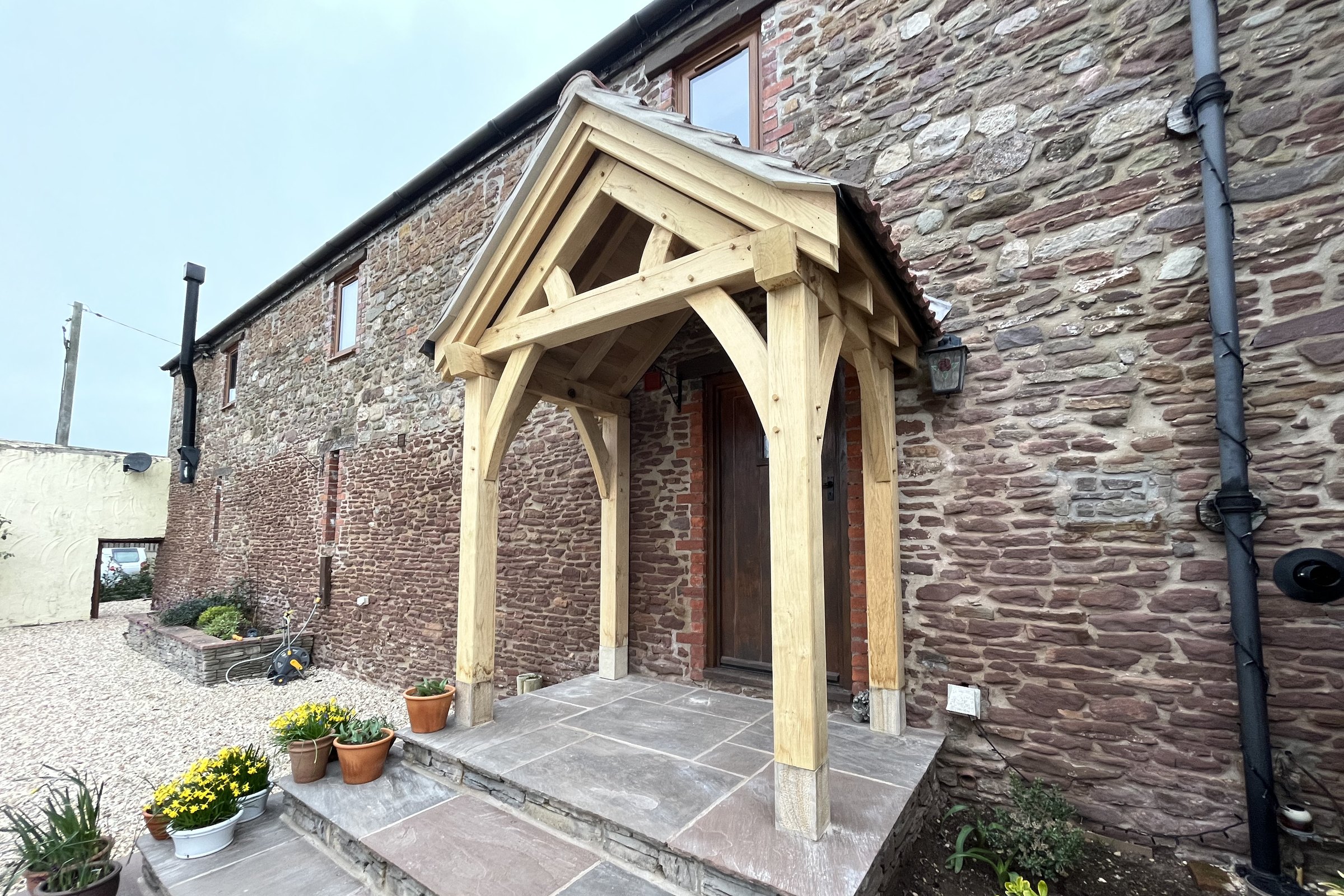
The commonest way an oak porch fails is at the feet, where a post stands in the wet. After that, what goes wrong comes from where the porch meets the house, the joints, the oak, the fixings and the finish, and from not knowing what green oak does in its first year. Almost all of it is decided before the porch goes up, and none of it is specific to one firm.
Why do oak porch posts fail at the bottom?
Because the bottom of the post keeps getting wet. Rain hitting the ground throws splash-back up the foot of a post, and a foot that wets and dries a few hundred times a year is where oak porches fail. Stand the post clear of the ground, on a staddle stone (a stone foot under the post) or a pad, by something like 150 mm, and the end grain never sits in water.
A post set straight onto paving or into concrete is the thing to walk away from. Oak kept in contact with the ground lasts decades rather than centuries. Which base suits your porch, from staddle stones to a plinth wall, is in Should an oak porch stand on a plinth wall or go to the ground?
FOXTAIL OAK. Where a post comes down to the ground, it stands on a staddle stone, 150 mm clear, in a choice of colours and finishes.

How should an oak porch be fixed to the house?
From the outside, without making a hole through the wall. A frame fixed externally with resin anchors, fixings bonded into the masonry, leaves no hole through the fabric of the house and so no path for water into it. Where the roof meets the wall, the lead flashing should be chased into the masonry, not stuck to the face of it. How the rest of the roof keeps the water out is in What roof should an oak porch have?
FOXTAIL OAK. We fix externally with resin anchors and chase the flashing in.
Will the joints on an oak porch work loose?
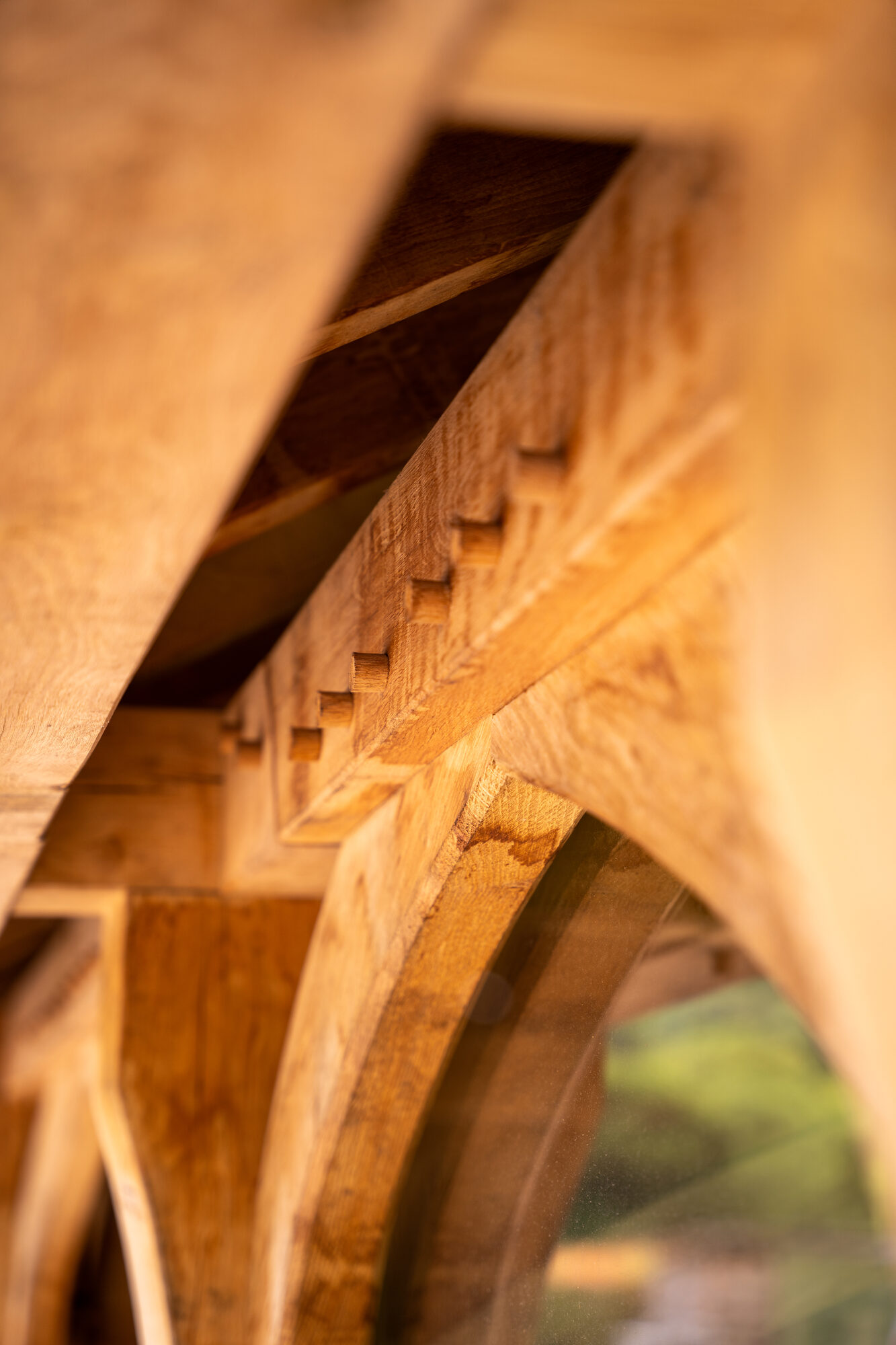
Not if they're pegged mortice and tenon joints. As the frame dries the timber shrinks onto the peg and the joint pulls tighter, so the frame gets stronger over the same years it looks like it's coming apart. If the structure relies on screws or brackets, ask why.
FOXTAIL OAK. Draw-pegged mortice and tenon joints throughout, and nothing structural on a screw. Our consulting engineer checks every frame we cut.
What oak should a porch be made from?
Graded structural oak, with the grade named in the quotation and the sapwood left out. Porch frames are normally cut green, fresh and still full of water, because the sections a frame needs can't be bought ready-dried. Structural oak is graded for its knots, grain and defects, and the grade should be in writing. Then ask whether the sapwood is excluded. Sapwood is the outer living wood: it has none of the heartwood's durability, insects go for it first, and it weathers to a different colour.
FOXTAIL OAK. QPA, the top structural grade, in strength class D30, and sap-free as standard on every green oak frame; it costs more and it's in every price. Curved braces show movement most, so as standard we cut them from air-dried oak, which has already done much of its drying. Air-dried oak is bought already cut, so it can't be guaranteed sap-free.
Why do the fixings on an oak porch matter?
Because the tannin in oak corrodes ordinary steel. It shows first as blue-black staining down the timber and in time as failed fixings. Stainless, or nothing: cheap to get right, expensive to get wrong, and invisible on a finished porch, which is why it's worth asking.
FOXTAIL OAK. Every fixing we use is stainless steel.
Does the finish on the oak matter?
Yes, because people touch a porch. Every face should be cleaned up smooth and every edge given a small chamfer, so nobody catches a splinter on something they walk past twice a day.
FOXTAIL OAK. We plane and chamfer every frame.
What happens to an oak porch in its first year?
It moves, splits, stains what's under it and changes colour, and none of that is a fault. Better you hear it now than notice it in February. A glazed porch has one more thing to get right, which is how the glass meets oak that's still moving; that's How do you stop a glazed oak porch leaking?
Shrinkage
As it dries, oak shrinks across its width: up to about 20 mm on a 200 mm post. That doesn't necessarily show as the whole post getting narrower. It might show as a crack down the middle, perhaps 10 mm wide, and a small loss of width.
Shakes
Fine splits, called shakes, open along the timber, and it twists very slightly. This is what people ring us about. It doesn't weaken anything, because the joints pull tighter as the timber shrinks onto the pegs. Oak dries about an inch a year, so a 150 mm post is in theory six years from green to dry, but most of the movement happens early.
Tannin
Rain washes tannin out of new oak. For the first year you may see brown streaking on the render or paving underneath, and it can run for months. It's harmless and it weathers off. We cover what's below while we're building, but sheeting only works while it's down, and an open porch shows more of it than a glazed one.
Silvering
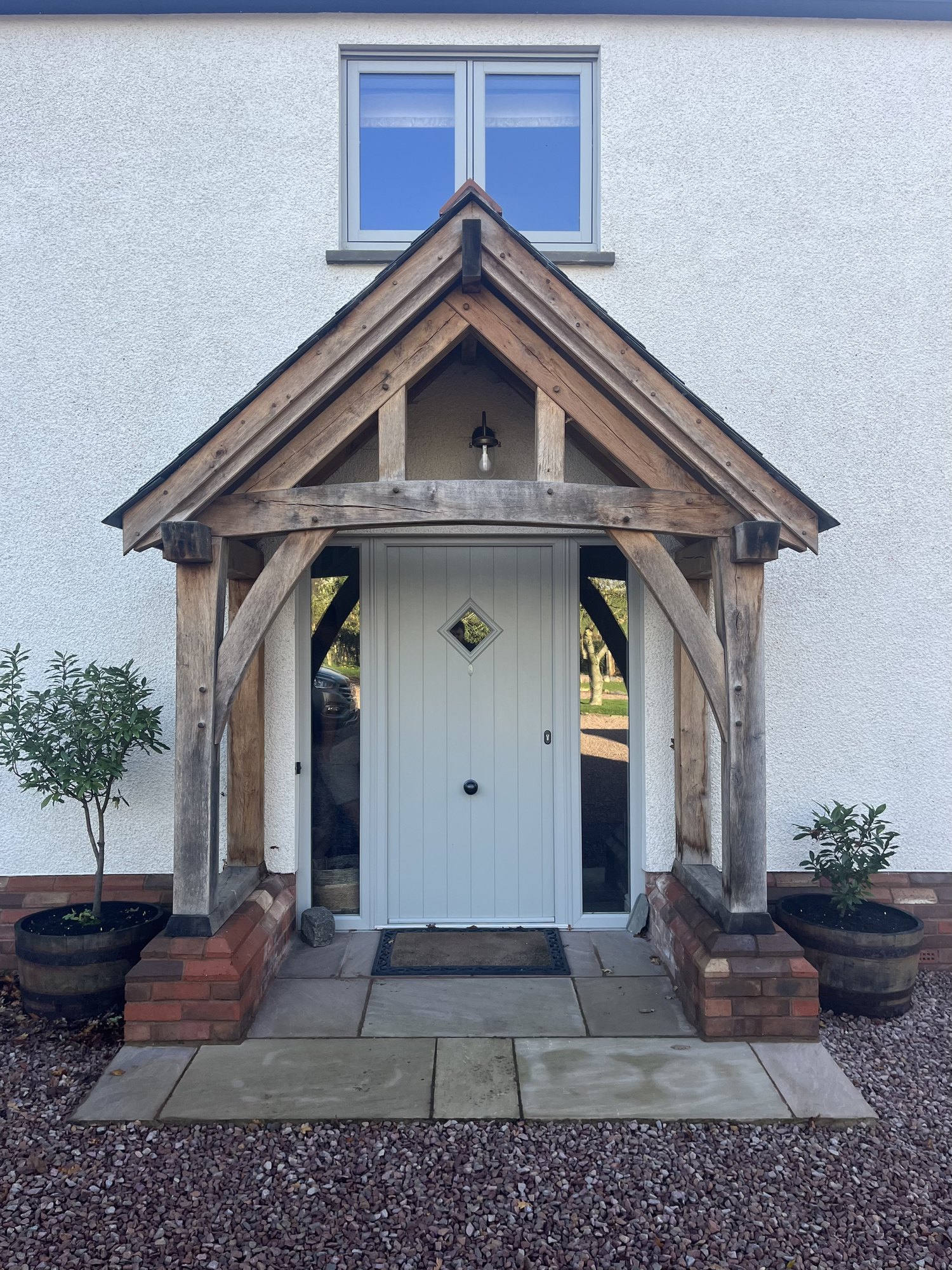
Exposed oak turns from honey to silver-grey. Ultraviolet light breaks down the lignin at the surface, rain washes it away, and the bare fibres left read as silver. It's microns deep. It doesn't arrive evenly: it starts low, where the feet catch splash-back, and on the sunniest faces, while oak under a deep eaves can stay honey-coloured for years. Give it two or three winters and it evens out.
How do you look after an oak porch?
Mostly by leaving it alone. The joints, pegs, fixings and structure need no treatment and no inspection. What wants a little attention comes in the first year or two.
- Tannin on the oak washes out on its own. If you'd rather not wait, a weak oxalic acid solution lifts it; test it somewhere out of the way first.
- Tannin on what's underneath is more obvious than on the oak. On masonry, sugar soap and a stiff brush takes most of it and a brick cleaner the rest. Wet the surface first, try a small patch, and check the product suits the surface.
- Gaps where the oak meets masonry open as the oak shrinks. Don't fill them in the first year or two, or you'll do it twice. Once it's settled, use a flexible sealant rather than mortar.
- Oil, or let it silver. Most people let it go. Holding the honey colour takes a UV-resisting exterior oil, kept up, because letting it lapse looks worse than never starting. An oiled porch needs re-oiling every year to keep its colour.
FOXTAIL OAK. Our first choice is to leave it untreated, and oiling isn't something we offer. If you want to treat it, we'd usually recommend an Osmo oil.
Who is an oak porch the wrong answer for?
Anyone who'd be unhappy with a frame that cracks, twists, streaks the paving and turns grey. Green oak does all four; good detailing only makes sure none of it matters. If that would bother you, a softwood porch painted and kept painted, or a canopy on brackets, is the other way to go. See Is an oak porch worth it over a softwood or GRP canopy?
What should you send us?
A photograph of the front of your house, a rough width, and what's on the ground where the posts would go. If you already have an oak porch and aren't sure whether a crack is normal, send a photograph of that too: we'd rather look at ten that are fine than miss one that isn't. To see a frame after a few winters, there are several finished porches within five minutes of our workshop near Abergavenny, and we'll take you to one. Get in touch through our contact page, or read more on oak frame porches.
Questions people ask next
Do the cracks mean the porch is failing? No. Shakes are the oak drying, and the pegged joints pull tighter as it does. A green oak frame is at its strongest a few years after it goes up.
Can I stop the oak going silver? Only by oiling it and keeping it up. Most people let it silver. In our experience it splits about evenly: some prefer the grey once it comes, and some would rather have kept the honey colour.
Related reading
Related
Oak frame porches
